To view this email as a webpage, visit our eNewsletter page.
Purple Martin Voice
Volume 1(10)
Purple Martin Voice is an eNewsletter distributed by Purple Martin Association of the Dakotas. Issues feature the plights and triumphs of Purple Martins in the Dakotas.
Research
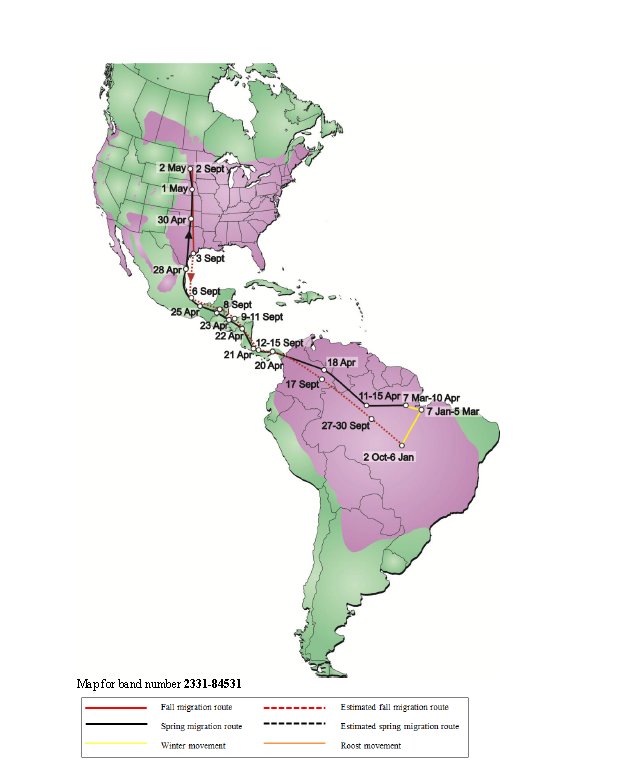
range map courtesy of Purple Martin Conservation Association and York University, © 2013
The spring Purple Martin migration is finished. If landlords have not attracted Purple Martins to their colony, there are little chances of attracting any breeding pair. Our best advice to landlords is to keep your housing open until after the first hard frost in autumn. While many Purple Martins are busy raising their young already, other females are still incubating eggs. Hatching year (HY) young will begin fledging during late July and into August. The HY young may seek out housing before migrating south for the winter. Closing all the housing in efforts to keep non-native site competitors away from the housing also keeps Purple Martins away. Controlling any non-native site competitors throughout the summer and autumn will help reduce these competitors for future seasons.
Eight after second year (ASY) Purple Martins were tracked with geolocators. Purple Martins exhibit strong site fidelity. Therefore, it is reasonable to expect the same Purple Martins to return to the colony where they raised young the previous season. While the Purple Martins are able to breed their second year, their site fidelity is not set as strong as an ASY Purple Martin. Nonetheless, a second year male (SY-M) Purple Martin was banded from a Columbia, South Dakota breeding colony in 2011 with band number 2331-84531 and was retrieved from the same Columbia, South Dakota breeding colony in 2012.
The SY-M began spring migration back to this Columbia, South Dakota colony from northern Brazil (Amazon River region) on April 11, 2012. This spring migration took over three weeks with the SY-M arriving back in Columbia on May 2, 2012. This SY-M traveled 5,180 miles in 22 days averaging 235 miles per day.
The SY-M left Columbia, South Dakota on September 3, 2011. The fall migration took a month to complete. His migration took 30 days arriving in northern Brazil on October 2, 2011 traveling 5,371 miles averaging 179 miles per day. The total annual migration distance traveled for this SY-M was an astonishing 10,551 miles.
Next season there will be all new sets of data. This data may include a Purple Martin that wore a geolocator for two years. Our hope is that this data will reveal even more about Purple Martins’ migration behavior.
Calendar
July 9, 2013 6:30 pm - 7:30 pm Project Martinwatch with Girl Scouts
For more information on events, visit our Calendar page.