To view this email as a webpage, visit our eNewsletter page.
Purple Martin Voice
Volume 2(2)
Purple Martin Voice is an eNewsletter distributed by Purple Martin Association of the Dakotas. Issues feature the plights and triumphs of Purple Martins in the Dakotas.
Research
In Volume 1 of the “Purple Martin Voice”, we shared information about South Dakota Purple Martin migrations recorded from new technological devices called geolocators. Cofounder, Paul Mammenga, was fortunate to collaborate with York University research scientists from Toronto, Canada and the Purple Martin Conservation Association (PMCA) in Pennsylvania. Funding for these “first-ever” devices used on Purple Martins from South Dakota was obtained from the Wildlife Diversity Program of the South Dakota Department of Game, Fish and Parks in cooperation with York University. A total of 33 geolocator devices were attached to Purple Martins and deployed from two nesting colonies in South Dakota in 2011. In nine different Volume 1 issues of the “Purple Martin Voice”, we shared migration maps and data obtained from each Purple Martin that returned with a geolocator. How exciting and great it was to see the “first-ever” migration map for a Purple Martin coming from the Dakotas and from this part of their breeding range in North America.
Enthusiastic collaboration and cooperation has continued with additional deployment of 20 geolocators in 2012 and 15 in 2013, with the majority of them launched from Paul’s colony near Columbia, South Dakota. In several Volume 2 issues of “Purple Martin Voice”, we will again share migration maps and information on six Purple Martin’s migrations. As Purple Martins with geolocators deployed in 2012 returned in spring of 2013, retrieval of geolocators revealed one geolocator was actually deployed in 2011 and had been on this particular Purple Martin for two years. This was a huge surprise and very exciting to learn that two migration data were still useable. We will begin with details for this Purple Martin first.
Dr. Kevin Fraser from York University gave this account after he completed analysis and mapping for this (what we will call) 2 year geo Purple Martin...
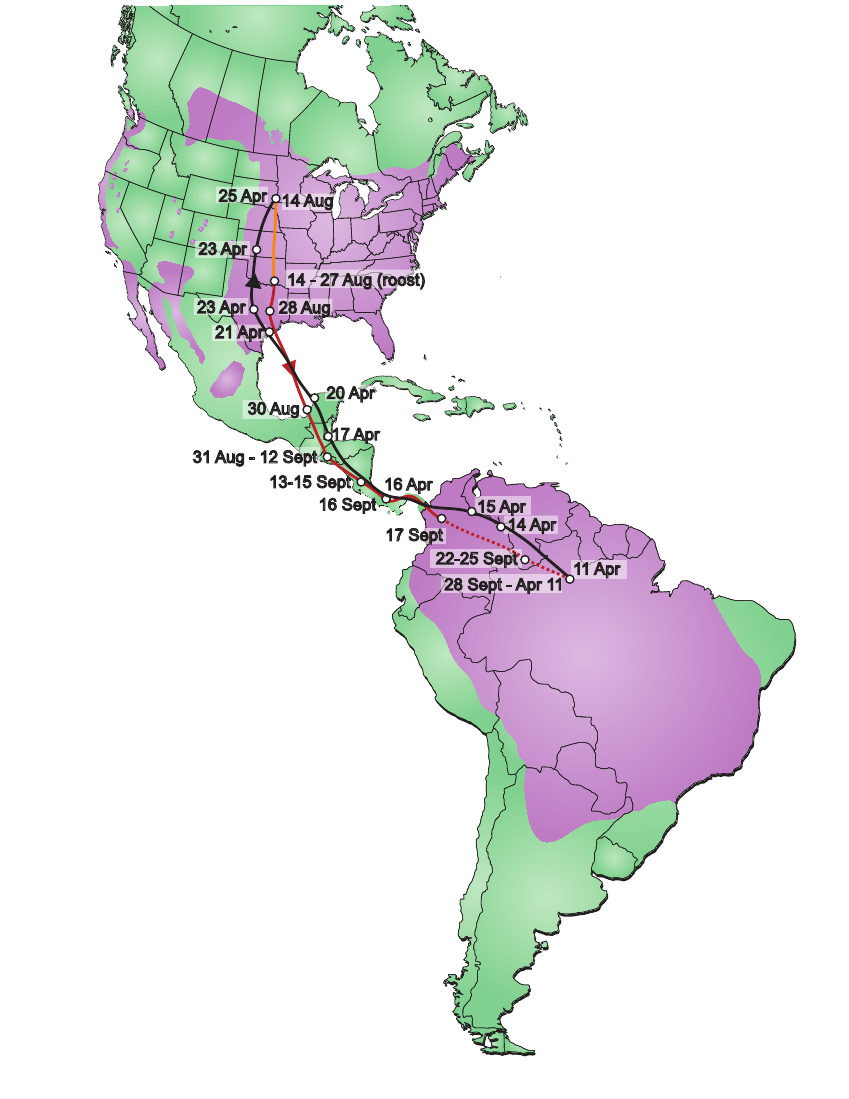
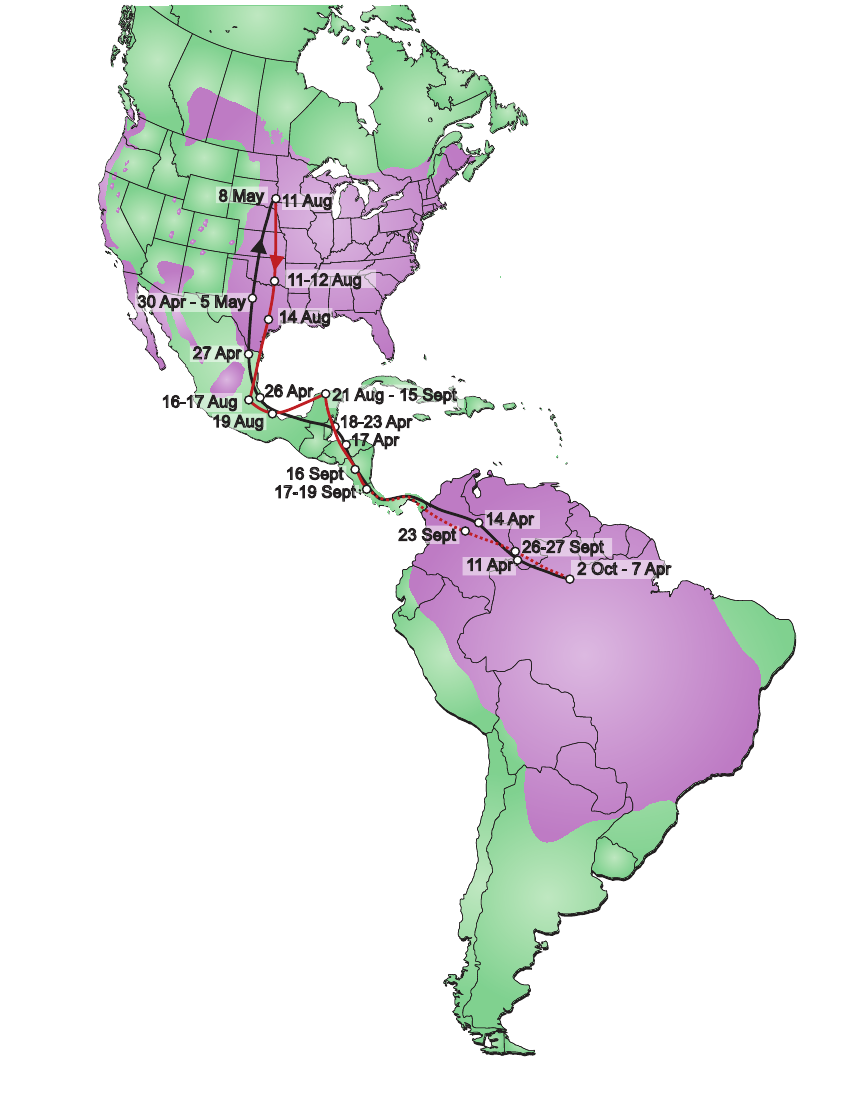
“This bird makes a fascinating 2 year comparison! (See both maps 1 and 2). Fall migration departure date was similar between the two years (August 14 in 2011 and August 11 in 2012). However, some differences appear after that. In 2011, this female stopped for 13 days in southern Oklahoma. I am calling this a fall roost site. We do sometimes see long fall stops a large distance away from breeding sites, and assume birds are joining large roosts, rather than just making a fall stopover. It is rare to see this on our data because I think that for most birds, their long fall roosts are near breeding sites. In 2012, this bird stopped in what looks to be the exact same location in southern Oklahoma, but only for one day (took only one day from the Sioux Falls colony to the Oklahoma roost site in both years). The overall migration routes of this bird in spring and fall were very similar, with the exception of at the Gulf of Mexico. In fall and spring migration of the 1st year of tracking, she went across the gulf. In the 2nd year of tracking, she went around the gulf in both spring and fall. This is very interesting, and I’d love to look more closely at what specifically makes birds adjust their routes at the gulf…I’m guessing that wind and other weather plays a big role, but it would be neat to examine more specifically.
Like we see in many martins, this individual had a long fall stop after arriving in Central America. In the 1st year, her stop was in Guatemala (31 Aug – 12 Sept), and in the 2nd it was at the tip of the Yucatan Peninsula (21 Aug – 15 Sept). In spring, this bird didn't have any stopover in the 1st year (see map 1), but stopped for a few days (18 – 23 Apr) in Belize in the 2nd year (map 2). This is an emerging pattern this spring (2013), where we have more commonly seen spring stopovers before crossing (or going around the gulf). I think that cold and windy weather may have slowed many martins down either before or after crossing the gulf. I’ll be looking at whether the conditions on spring migration, did indeed slow many of our birds down, resulting in later arrival at breeding sites in 2013. For winter sites, this bird was a bit unusual, in that she had just one winter roost location in both years. Even more interesting, this location looks to be in the exact same location in the middle of the Amazon Basin in Brazil in both years. There was a lot of interesting data with this bird!”
We thank you Dr. Fraser for your account on this amazing Purple Martin.
Here is some other information obtained from this adult female’s migrations. She arrived on the wintering roost the 1st year on 28 Sept and on 02 Oct the 2nd year. Total fall migration from colony the 1st year was 4,442 miles and on the 2nd year the total was 4,860 miles. Fall migration the 1st year took her 46 days from colony to winter roost and 53 days the 2nd year.
She departed on spring migration from the wintering roost about the same time both years, 11 April the 1st year and 08 April the 2nd year. Total spring migration from wintering roost back to the colony site in Sioux Falls was 4,499 miles the 1st year and 4,671 miles the 2nd year. Spring migration the 1st year took her only 15 days while the 2nd year took 31 days showing the effects of the cold weather conditions in the spring of 2013. Total annual migration distance was 8,941 miles the 1st year with 9,531 miles covered the 2nd year. The number of days she spent at the breeding colony in Sioux Falls the 1st year was 113 days which represented 31% of total year, while in the 2nd year she spent 93 days (25%) of the year. The number of days she spent at the wintering roost the 1st year was 205 days (56%) of the year, while in the 2nd year she spent 188 days (52%) of the year at the winter site.
We hope that you find this research using geolocators on Purple Martins as amazing and fascinating as we do. For the first-time this year, York University researchers will be utilizing GPS tags (similar to geolocators). The Purple Martin Association of the Dakotas is hoping to partner and sponsor this latest and most advanced technological device. So far sponsorships for two GPS tags have been funded from two sponsors in South Dakota: Missouri Breaks Audubon and Brookings Wildlife Federation chapters. These GPS tags will be deployed on Purple Martins in South Dakota from the breeding colonies where geolocator research is currently being conducted. These GPS tags will provide more accurate data and will NOT have to be retrieved like geolocators to collect data on the Purple Martin’s “where-abouts”. We are excited to collaborate with York University and PMCA on this continuing research. Please help the Purple Martin Association of the Dakotas accomplish our donation goal of $400 to sponsor one GPS tag for this continued research.
Please make your donation to the GPS Device Project. You can send a check payable to Purple Martin Association of the Dakotas, 703 Barley Court, Grand Forks, ND 58201-8066 or make a secure online donation using PayPal.

If you have questions, call or email me at (218) 791 – 3689 or Perry@PurpleMartinDakotas.org.
Map 1 - range map courtesy of Purple Martin Conservation Association and York University, © 2014
Map 2 - range map courtesy of Purple Martin Conservation Association and York University, © 2014
Calendar
Tuesday, May 6, 12pm – 1pm Midwest Aerial Insectivore Working Group Bi-monthly Conference Call
Saturday, June 7, 9am – 3pm Outdoor Purple Martin Festival
For more information on events, visit our Calendar page.
Outdoor Purple Martin Festival
The Outdoor Purple Martin Festival tickets went on sale Monday, March 10, 2014 at 12:00 PM CDT. Tickets are available through May 31, 2014 at 11:59 PM CDT, unless sold out prior to the event. Tickets are available for purchase online. Please note Yapsody is our ticketing partner who sells tickets without ticketing fees.