To view this email as a webpage, visit our eNewsletter page.
Purple Martin Voice
Volume 2(3)
Purple Martin Voice is an eNewsletter distributed by Purple Martin Association of the Dakotas. Issues feature the plights and triumphs of Purple Martins in the Dakotas.
Notes
Opening the eCommerce Center was nerve wracking. One week after our launch, the news about the OpenSSL Heartbleed bug came to light. The OpenSSL Heartbleed bug is being called the biggest security threat the Internet has ever seen. It affected many popular websites and services. Our eCommerce Center shop.PurpleMartinDakotas.org was not affected or exposed by the OpenSSL Heartbleed bug.
Outdoor Purple Martin Festival
Tickets are available through May 31, 2014 at 11:59 PM CDT, unless sold out prior to the event. Purchase tickets online or by calling our box office at (218) 791 - 3689.

Research
In the last issue of the “Purple Martin Voice”, we learned migration details on an adult female Purple Martin that carried a geolocator on her back for two years resulting in two migration maps. One goal, in the collaborative cooperation in 2012 with York University and Purple Martin Conservation Association, was to participate in redeployment of another geolocator on Purple Martins that carried a geolocator in 2011 to study “multiple” migration routes from the same Purple Martin. A total of 6 Purple Martins, that had geolocators retrieved in 2011, were redeployed in 2012 with another new geolocator along with 14 new deployments at 2 colony sites in South Dakota. Only 1 of the 6 redeployments returned in 2013 to provide data for “multiple” migrations. We are happy to share information learned on this adult male’s two migrations.
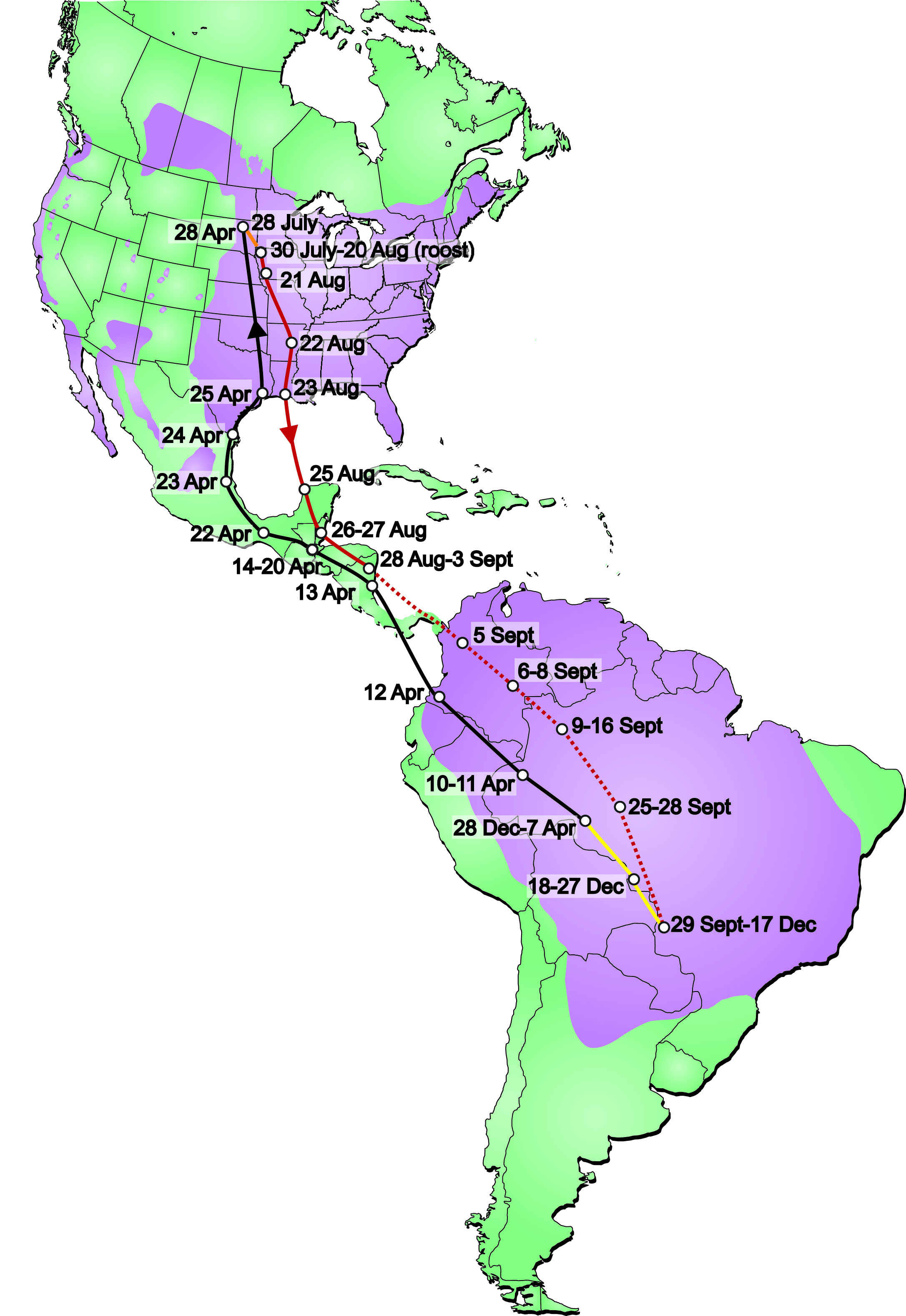
In his first migration (see Map 1), he left the Columbia, South Dakota breeding colony site on 28 July. He stopped in Sioux Falls, South Dakota for 22 days (until 21 August) at what we believe was a pre-migratory roost. It took him only two days to reach the Gulf of Mexico coast after leaving the roost site. He then took a path over the Gulf of Mexico taking only two days to reach the Yucatan Peninsula. Migration then slowed with this male spending about 10 days in Central America before continuing on through the central portion of South America and reaching his first winter roost area in southeastern Brazil on 29 September. This adult male began his spring migration back to the breeding colony on 7 April. This spring migration path took a little more of a western route by going around the Gulf of Mexico instead of through it like he did in the fall migration. It took him around 21 days to make this spring migration back to the breeding colony on 28 April.
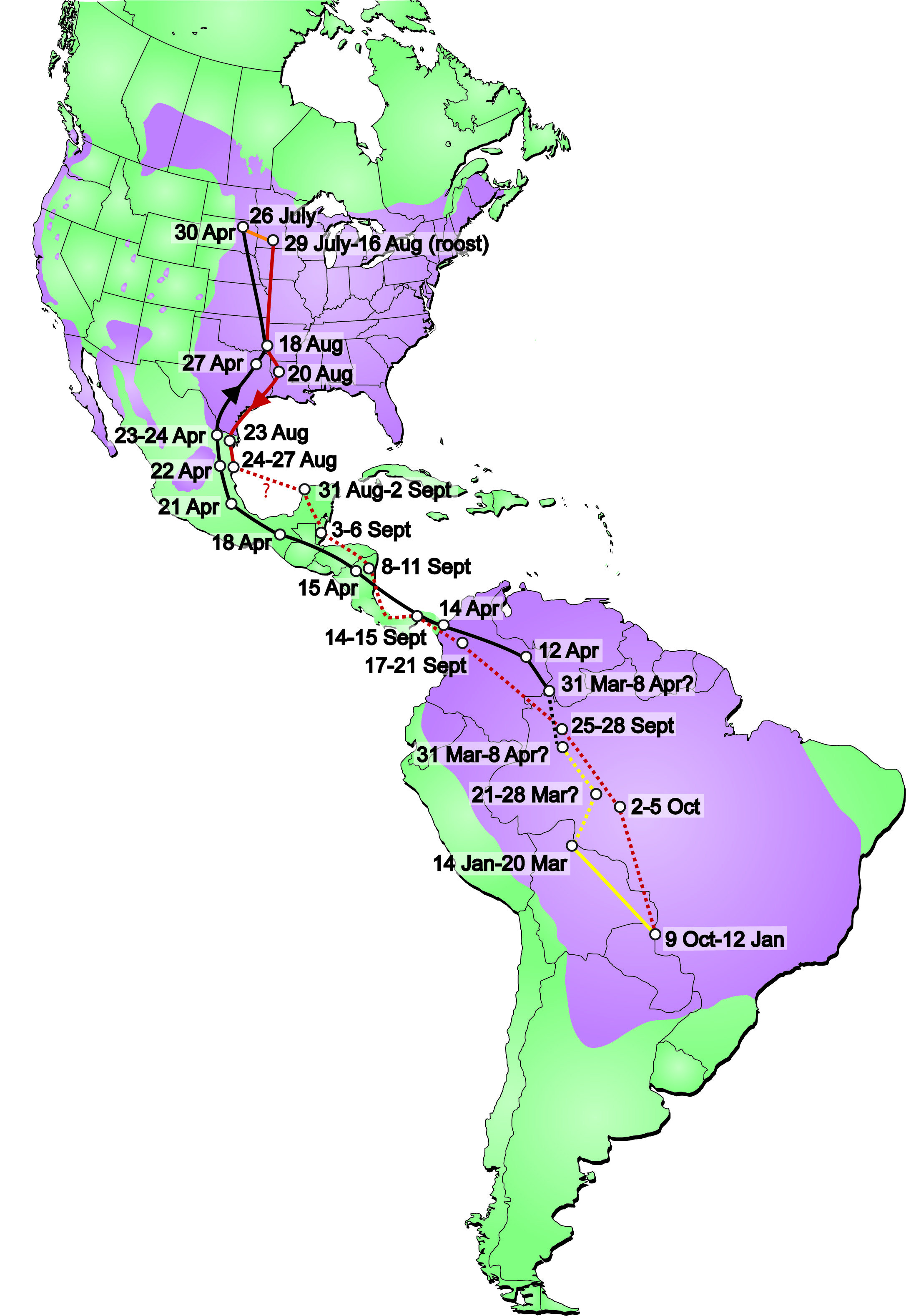
Now let’s look at and compare his first annual migration to his second annual migration (see Map2). He left the colony site on about the same date, 26 July, as the first departure date. When he left the colony site, he again spent time at a pre-migratory roost, but this time the roost was in south-central Minnesota. After 18 days at this roost, he continued on his migration which was a different path than his first migration. Instead of crossing the Gulf of Mexico straight to the Yucatan Peninsula, he traveled around the Gulf of Mexico before reaching the Yucatan Peninsula at the same location as in his first migration route. On this second migration, he spent a good two weeks in Central America before continuing through South America to the first winter roost location. He began his spring migration on 8 April which was about the same date as the first year, but was, again, a different route through South America. He followed approximately the same route through Central America and around the Gulf of Mexico arriving back to the breeding colony on 30 April which was about the same date as his first migration.
Here is some other information obtained from this adult male’s migrations. Total fall migration from the colony the first year was 5,562 miles, and the second year total was 6,609 miles. Fall migration for both years took him 62 days from the colony to the winter roost.
Total spring migration from wintering roost back to the colony site in Columbia, South Dakota was 4,953 miles the first year and 4,092 miles the second year. Spring migration the first year took him 21 days while the second year was very similar with 22 days. Total annual migration distance was 10,515 miles the first year and 10,478 miles the second year. The number of days he spent at the breeding colony the first year was 113 days (31% of a year), while the second year was 138 days (38% of a year). The number of days he spent at the wintering roost the first year was 191 days (52% of a year), while the second year was 162 days (44% of a year).
We hope you find this research using geolocators on Purple Martins as amazing and fascinating as we do. The Purple Martin Association of the Dakotas is hoping to sponsor a new technological device for continuing research called a GPS tag (similar to geolocators) this summer. Please help the Purple Martin Association of the Dakotas reach our sponsorship goal of $400 for one GPS tag. Any amount you can give to help us reach this goal for continued research is greatly appreciated.

If you have questions, call or email me at (218) 791 – 3689 or Perry@PurpleMartinDakotas.org.
Map 1 - range map courtesy of Purple Martin Conservation Association and York University, © 2014
Map 2 - range map courtesy of Purple Martin Conservation Association and York University, © 2014
Calendar
Tuesday, May 6, 12pm – 1pm Midwest Aerial Insectivore Working Group Bi-monthly Conference Call
Saturday, June 7, 9am – 3pm Outdoor Purple Martin Festival
For more information on events, visit our Calendar page.