To view this email as a webpage, visit our eNewsletter page.
Purple Martin Voice
Volume 1(2)
Purple Martin Voice is an eNewsletter distributed by Purple Martin Association of the Dakotas. Issues feature the plights and triumphs of Purple Martins in the Dakotas.
Research
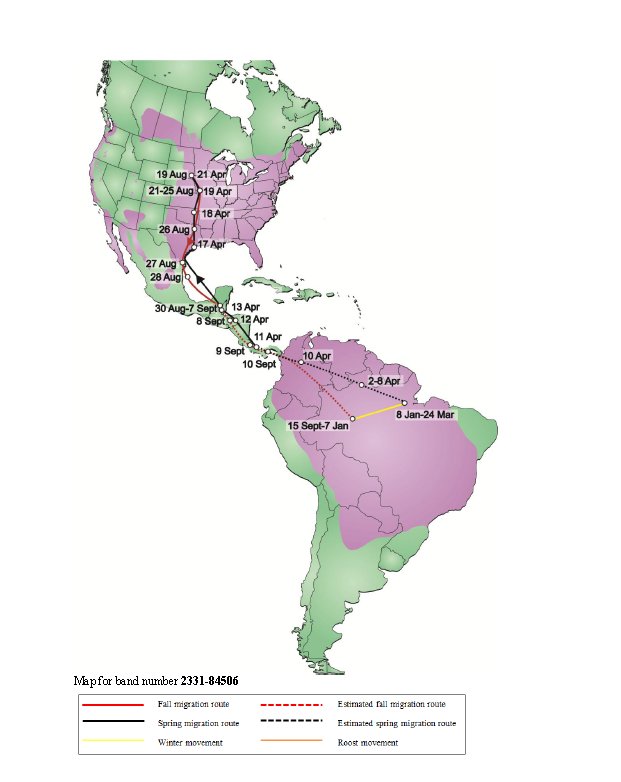
range map courtesy of Purple Martin Conservation Association and York University, © 2013
In the last eNewsletter, we learned about a male Purple Martin deployed with a geolocator from a Sioux Falls breeding colony. We will now learn about a female deployed from the same colony.
Purple Martins from the Dakotas will start leaving wintering roosts in Brazil for the spring 2013 migration back to the Dakotas before our next eNewsletter is distributed. An after second year female (ASY-F) banded from the same Sioux Falls, South Dakota breeding colony in 2011 with band number 2331-84507, began spring migration back to this Sioux Falls colony from northern Brazil (Amazon River region) on April 22, 2012. This spring migration took about two weeks with the ASY-F arriving back in Sioux Falls on May 6, 2012. This ASY-F traveled 4,450 miles in 15 days averaging 296 miles per day.
Fall migration usually takes a more leisurely approach and, in the case of this ASY-F, the fall migration took about a month and a half to complete. Leaving Sioux Falls, South Dakota on August 22, 2011, her migration took 44 days arriving in northern Brazil on October 4, 2011 traveling 4,645 miles averaging 106 miles per day. The total annual migration distance traveled for this ASY-F was 9,095 miles.
Through geolocator research we are able to identify the important biomes and ecosystems that Purple Martins utilize. We are interested in knowing more about the pesticide usage in some of these regions as Purple Martin eat exclusively insects. Bald Eagles were nearly pushed to extinction partially due to thinning eggshells caused by DDT (dichlorodiphenyltrichloroethane) contamination (1). The early usage of DDT gained widespread popularity after 1945 due to its efficiency, persistence, usefulness, and value (2). The United States banned DDT in 1972 (3); however it is still used in Mexico and Central America to fight malaria-spreading mosquitoes (4). Purple Martins may pickup DDT during their long-distance migration. More research is needed to understand the low population abundance trend shown for both North Dakota and South Dakota. Future research should include an analysis of any pesticide exposures Purple Martins could encounter.
For more information on geolocator research, visit our Research page.
Literature Cited
1. http://www.epa.gov/aboutepa/history/photos/h13.html
2. http://www.epa.gov/aboutepa/history/topics/ddt/02.html
3. http://www.epa.gov/aboutepa/history/topics/ddt/01.html
4. http://www.unep.org/Documents.Multilingual/Default.asp?DocumentID=585&ArticleID=6148&l=en
Notification
We overlooked including "range map courtesy of the PMCA/Purple Martin Conservation Association, © 2013" adjacent to the image in Purple Martin Voice Volume 1(1). The geolocator research is being conducted in partnership with York University scientist Bridget Stutchbury, her staff, the Purple Martin Conservation Association, and other landlords.
Conservation
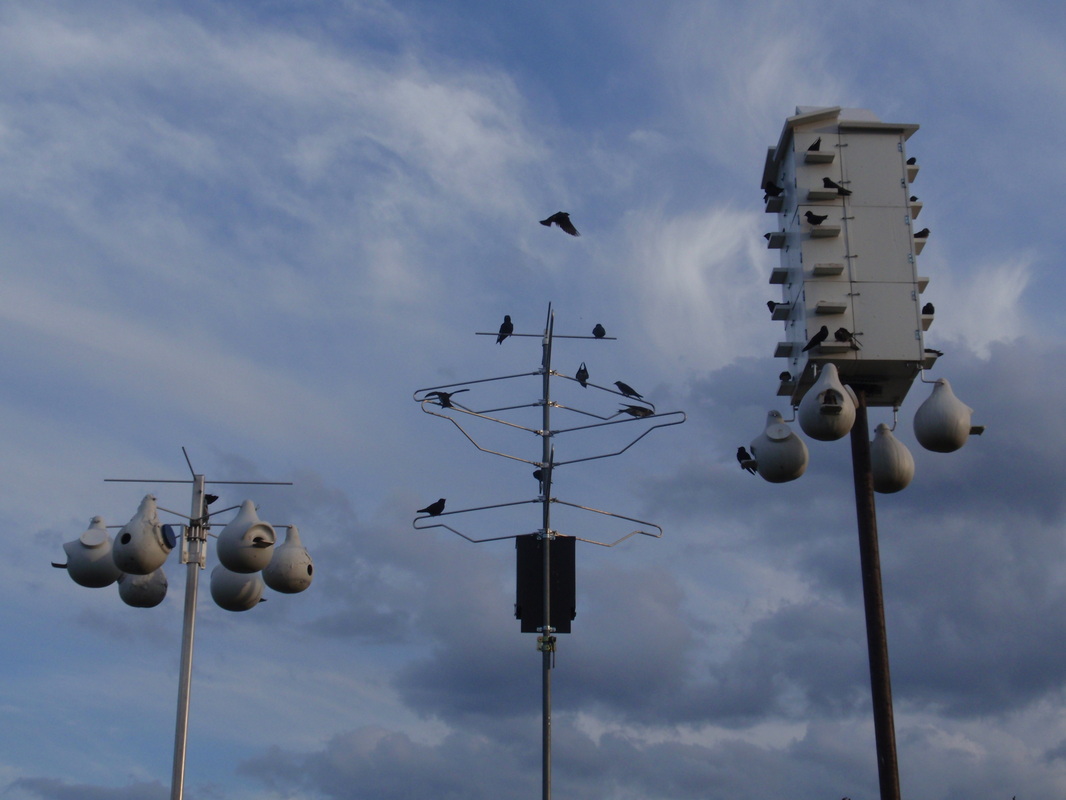
The North American Breeding Bird Survey Trend Results show, with moderate precision, Purple Martin population declines in both Manitoba Canada and Minnesota. The trends also show low abundance in both North Dakota and South Dakota. The Minnesota Department of Natural Resources is proposing to officially list the Purple Martin as a species of “Special Concern” as Purple Martins have declined greatly in Minnesota. Purple Martin Association of the Dakotas, in partnership with several other organizations, are working to change these trends in northwestern Minnesota. These other organizations include Agassiz Audubon Society, Greenway of Greater Grand Forks, Middle-Snake-Tamarac Rivers Watershed District, Minnesota Purple Martin Working Group, Purple Martin Conservation Association, and Midwest Aerial Insectivore Conservation and Monitoring Working Group.
The North Red River Valley Purple Martin Project was made possible in part from a grant sponsored by Songbird Essentials and the Purple Martin Conservation Association. The grant was awarded to Purple Martin Association of the Dakotas in collaboration with Agassiz Audubon Society. It was not long before nonconventional partnerships were developed with the managing organizations of two flood protection systems, the Middle-Snake-Tamarac Rivers Watershed District and the Greenway Greater Grand Forks.
The Middle-Snake-Tamarac Rivers Watershed District manages the Agassiz Valley Water Resource Management Project located in northwestern Minnesota. The impoundment, comprised of four square miles, was designed to control the flow of water for the Red River of the North Basin in both Marshall and Polk Counties. The Agassiz Valley Water Resource Management Project is one of the newest stops on the international Pine to Prairie Birding Trail, which includes a mile-long gravel road and parking area atop the impoundment overlooking the largest pool. A dry area on the impoundment is home for the Agassiz Audubon Society Purple Martin Site.
The Greenway of Greater Grand Forks was created shortly after 1997 when the Red River of the North, which lies between the cities of Grand Forks, ND and East Grand Forks, MN, flooded almost every home and business within five miles of Greater Grand Forks. The Army Corps of Engineers proposed to build a levee system to contain the floodplain of the river, and subsequently the land between the levees was transformed into the nation's first bi-state greenway. The Greenway of Greater Grand Forks is more than a device for flood mitigation along the Red River of the North. The Greenway provides over 2,200 acres of natural space, an extensive system of trails, a wide variety of year-round recreational activities, educational and environmental benefits, and improves and restores the ecological stability of the Red River corridor. An open area on the dry side of the Greenway, adjacent to the Grand Forks Near Southside Historic District, is home for the Greenway of Greater Grand Forks Purple Martin Site.
Both new sites are using new management techniques with intentions to restore Purple Martin populations. Both sites are equipped with identical Lonestar systems. Our expectation was to interest visitors with hopes of attracting a pair or two of Purple Martins. Our success was more than anticipated when seven Purple Martins were attracted to the Greenway of Greater Grand Forks Purple Martin Site, and three breeding pairs fledged twelve young. While the Agassiz Audubon Society Purple Martin Site did not attract Purple Martins, it has great potential in upcoming seasons. In the upcoming seasons, we hope the Minnesota Purple Martin Working Group will be banding Purple Martins from this site for inclusion in their scientific studies. Currently Minnesota and South Dakota are leg banding Purple Martins.
A natal dispersal study is underway in South Dakota similar to efforts with landlords from Minnesota and Saskatchewan Canada. Young from established colonies in South Dakota are leg banded before they
fledge in later summer. The yellow-colored leg bands and silver-colored U.S. Fish and Wildlife Service leg bands are used to uniquely identify individual Purple Martins. Leg bands can be identified and read by landlords or residents several states away. We ask all birders, landlords, and residents to watch for any banded Purple Martins. Band information or band returns are uncommon for song birds. Your help is a contribution to the scientific research being conducted. We may only received information on about one or two bands from the hundreds of Purple Martins banded.
Our goals in North Dakota are to collaborate with individuals holding both federal and state banding permits for Purple Martins and to gain more complete knowledge about the Purple Martin population trends. The research will provide new insights into Purple Martins populations west of the Mississippi River which includes the Prairie Pothole Region of North Dakota. Collecting banding data from North Dakota and adding it to the information already being collected in Minnesota, South Dakota, and Saskatchewan Canada may help further identify the causes of regional declines.
Calendar
March 31, 2013 1 pm - 3 pm Enhancements to Turtle River State Park Purple Martin Site
April 7, 2013 6 pm - 8 pm Raising the Purple Martin Housing System
April 27, 2013 10:30 am - 11:15 am 2013 Gardening Saturday - How to Attract the Birds You Want to See in Your Yard
April 27, 2013 1:45 pm - 3 pm 2013 Gardening Saturday - Getting Started Bird Watching
June 1, 2013 11 am - 11:45 am Getting Started with Purple Martins
June 15, 2013 9 am - 3 pm Purple Martin Association of the Dakotas 2nd annual Outdoor Martin Fest
For more information on events, visit our Calendar page.
Announcement
Purple Martins Arrive Next Door in Nebraska!
Outdoor Martin Fest Sponsorship Received:
•ERVA / Nature House
If you, someone you know, or your company wants to sponsor the Outdoor Martin Fest, visit our Sponsor page.